
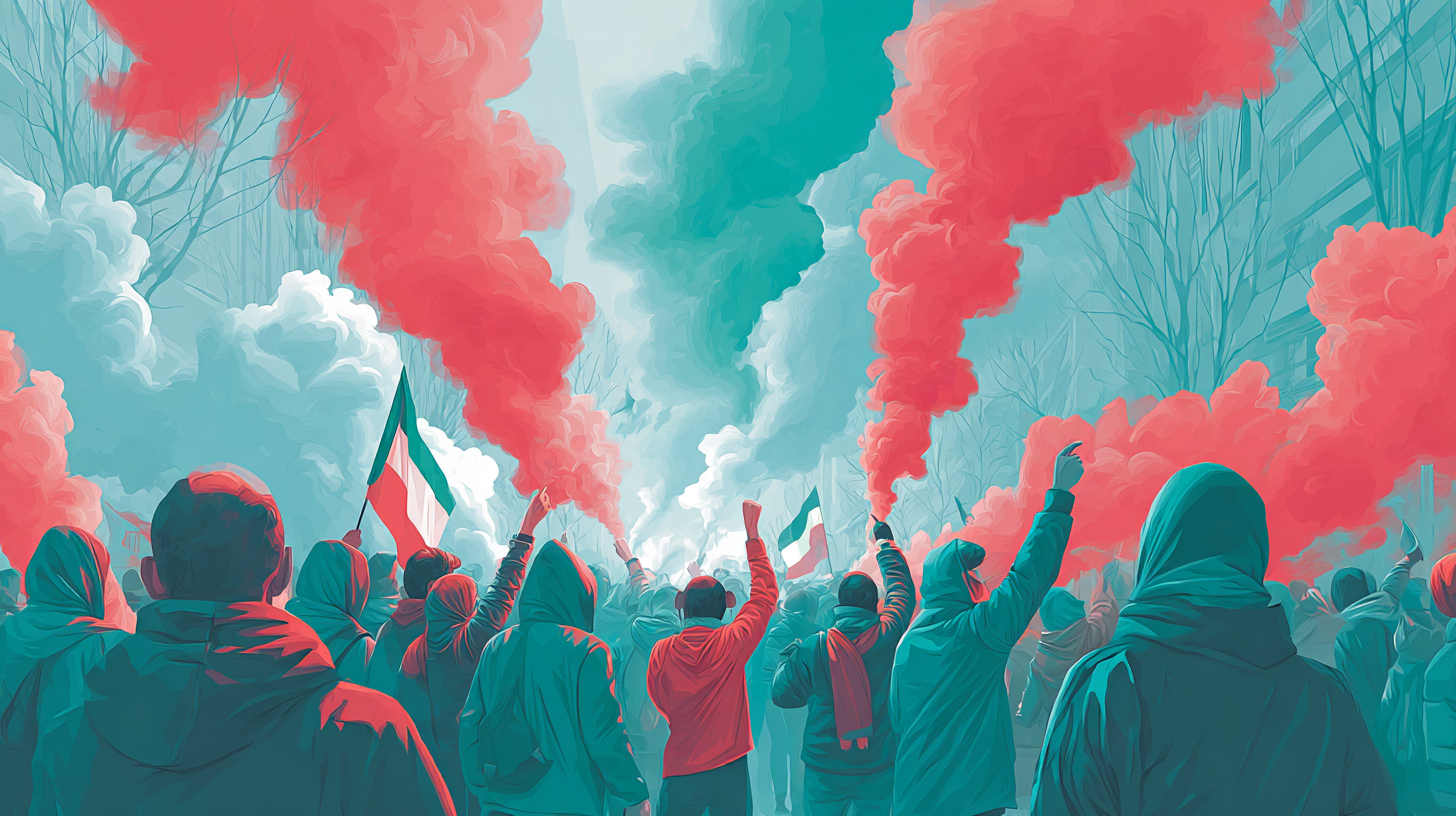
Iran, one of America’s fiercest adversaries, is gripped by widespread anti-government protests, marking one of the most significant waves of unrest in recent years. These demonstrations have spread across all 31 provinces and have evolved from economic grievances into broader calls for regime change.
Protesters, including merchants, students, and workers, have clashed with security forces, leading to violent crackdowns, internet blackouts, and a rising death toll.
The movement reflects deep-seated frustrations with the Islamic Republic’s governance, echoing patterns from Iran’s turbulent protest history while posing geopolitical implications, including potential benefits for U.S. interests.
When the Protests Started and Other Details
The current protests erupted on December 28, 2025, primarily in Tehran’s Grand Bazaar, a historic economic hub. They quickly escalated, spreading to major cities like Mashhad, Isfahan, Shiraz, and Tabriz, as well as rural areas.
By January 8, 2026, demonstrations had intensified, with large crowds in Tehran chanting slogans and setting fires, including to posters of Supreme Leader Ayatollah Ali Khamenei.

Reports indicate participation from diverse groups: bazaar merchants shuttered shops in strikes, students joined in university campuses, and nighttime protests turned into confrontations with riot police.
Key details include a nationwide internet blackout imposed by the regime starting around January 7-8, 2026, which has hampered communication and limited international access to footage. Despite this, videos smuggled out show protesters blocking roads, burning regime symbols, and facing tear gas, batons, and live ammunition. Human rights groups, such as Amnesty International and the Norway-based Iran Human Rights, estimate at least 45 deaths and hundreds of injuries by January 9, with some unverified reports from Tehran hospitals claiming over 200 fatalities.
The regime has deployed foreign mercenaries, including from Afghanistan and Iraq, to bolster security forces, amid fears of defections. Khamenei has publicly vowed no retreat, labeling protesters as “enemies” influenced by foreign powers like the U.S. and Israel. Exiled figures, such as Crown Prince Reza Pahlavi, have called for mass demonstrations, amplifying the unrest.
The scale is unprecedented in recent memory, with protests reported in nearly every province, from urban centers to border regions. Economic strikes have paralyzed markets, and chants like “Death to the dictator” and pro-monarchy slogans (e.g., referencing the Pahlavi era) have become common. Tensions remain extremely high, with reports of arson on government buildings and increased security in Tehran.
Why Are They Protesting? Was There a Triggering Event?
The protests were triggered by a sharp economic collapse, specifically the Iranian rial plummeting to an all-time low against the U.S. dollar on December 28, 2025. This currency devaluation, amid inflation rates exceeding 40-50%, made basic goods unaffordable and wiped out savings for millions. The government’s decision to end subsidized dollar allocations for importers exacerbated shortages of essentials like food and medicine.

Chronic mismanagement, corruption, and international sanctions—stemming from Iran’s nuclear program and support for militant groups—have compounded these issues, leading to widespread poverty and unemployment.
While economic hardship was the spark, the protests rapidly politicized, with demonstrators demanding an end to theocratic rule. Chants have shifted from complaints about prices to “Woman, Life, Freedom” (echoing past movements) and direct attacks on Khamenei and the Islamic Revolutionary Guard Corps (IRGC).
Underlying factors include repression of women’s rights, political freedoms, and ethnic minorities, as well as the regime’s funding of proxies like Hezbollah and the Houthis at the expense of domestic welfare. The bazaar merchants, a traditionally conservative but economically influential group, initiated strikes, signaling broad disillusionment.
History of Similar Protests in Iran
Iran has a long history of protests against its theocratic regime, often blending economic woes with demands for political reform.
- The 1979 Islamic Revolution itself began as anti-monarchy demonstrations but led to the current system.
- In 2009, the Green Movement erupted after disputed elections, with millions protesting alleged fraud; it was brutally suppressed, resulting in dozens of deaths.
- 2017-2018 saw nationwide unrest over economic inequality, spreading to over 100 cities and leading to at least 25 deaths.
- The 2019 protests, triggered by fuel price hikes, were among the bloodiest, with estimates of 1,500 killed in a government crackdown.
- In 2022, the death of Mahsa Amini in morality police custody sparked the “Woman, Life, Freedom” movement, focusing on women’s rights and hijab laws; it lasted months, claimed over 500 lives, and inspired global solidarity.
These cycles reveal a pattern: economic triggers ignite broader anti-regime sentiment, met with repression, internet shutdowns, and foreign blame.
The current wave fits this mold but stands out for its rapid spread and involvement of conservative sectors like the bazaar, potentially signaling deeper regime fragility.
Desperate Actions by the Regime

The Iranian government, facing one of the most widespread and sustained protest waves since the 1979 Revolution, appears increasingly desperate in its efforts to contain the unrest.
- Nationwide Internet and Communications Blackout
Starting around January 8, 2026 (during the 12th day of protests), authorities imposed a sophisticated, near-total shutdown of internet access, mobile data, and even some telephone services across the country. Monitoring groups like NetBlocks confirmed this as one of the most severe blackouts in Iran’s history, cutting off communication to limit coordination among protesters, prevent footage from spreading globally, and obscure the scale of violence. Activists and Nobel laureate Shirin Ebadi have warned this provides cover for potential massacres, with reports of hundreds treated for injuries (e.g., eye wounds from pellets) in Tehran hospitals alone. The blackout has isolated Iran, hindering verification of events while protests persist via smuggled videos and satellite workarounds like Starlink. - Intensified Violent Crackdown and Lethal Force
Security forces (including IRGC, Basij, and police) have escalated to widespread use of live ammunition, shotguns with metal pellets, tear gas, and stun grenades, even in urban areas. Human rights organizations (e.g., Amnesty International, Iran Human Rights, HRW) report at least 45–57 confirmed deaths early on (including children), with activist estimates soaring to over 500 killed and thousands injured or detained by January 11. Reports describe indiscriminate shootings in Tehran streets, raids on hospitals to arrest wounded protesters, and forces entering universities or homes. The attorney general has threatened charges of “enmity against God” (carrying the death penalty) against participants or even supporters. This brutality contrasts with initial restraint in some areas, suggesting a shift as the regime loses control. - Deployment of Foreign Militias and Mercenaries
Amid concerns over loyalty or sufficiency of domestic forces (fears of defections or refusal to fire on civilians), the regime has reportedly imported foreign fighters. Sources indicate hundreds to ~800 from Iraqi Shiite militias (e.g., Kata’ib Hezbollah, Harakat al-Nujaba, Badr Organization, Popular Mobilization Forces) and possibly Lebanese Hezbollah or Afghan Liwa Fatemiyoun. These Arabic-speaking groups are assisting in suppression, with videos showing non-Iranian accents and chants during clashes. The U.S. State Department has issued warnings against this, viewing it as a sign of desperation. Analysts note this tactic (used historically) reflects internal weakness, as relying on proxies risks further alienating the population. - Limited Economic Concessions and Leadership Shuffles
To placate economic grievances, the government replaced the central bank governor, paused certain currency subsidies (risking short-term price spikes), and rushed through a revised 2026–2027 budget with increased public sector salary hikes (up to 43%), maintained low VAT, and ~$8.8 billion in subsidized credits for essentials (providing minimal monthly aid, mocked by many as insufficient given ~50%+ inflation). President Pezeshkian initially acknowledged “legitimate” protests and promised dialogue, but hardliners (including Khamenei) have dismissed them as foreign-orchestrated “riots.” These moves appear reactive and inadequate against demands for systemic change. - Rhetorical Escalation and Preemptive Threats
Khamenei has vowed no retreat, labeling protesters “vandals” and “saboteurs” backed by the U.S. and Israel. The regime accuses foreign powers of instigation and has warned of “preemptive measures” against external threats (e.g., U.S./Israeli intervention). This defensive posture, combined with blaming outsiders, highlights isolation amid regional setbacks (e.g., weakened proxies like Hezbollah).
These actions reflect a regime viewing the protests as a potential tipping point toward collapse, especially with broad participation (including conservative bazaar sectors) and external factors like U.S. threats. While repression has slowed momentum in some areas, protests continue defiantly, with chants evolving toward regime change and monarchy restoration. The blackout and foreign fighter involvement particularly underscore desperation, as the government sacrifices legitimacy to cling to power. Outcomes remain uncertain, but the scale suggests the Islamic Republic faces its gravest internal challenge in decades.
Trump’s Response to Iran
President Donald Trump has strongly supported the ongoing anti-regime protests in Iran (sparked by economic collapse in late December 2025), repeatedly warning the Iranian government against killing or executing protesters and threatening U.S. intervention, including military options, while urging demonstrators to persist and promising American assistance.
He has framed the unrest as a potential path to freedom for Iranians, criticized the regime’s crackdown as “senseless killing,” canceled meetings with Iranian officials until violence stops, imposed new tariffs on Iran’s trading partners, and suggested the U.S. is “locked and loaded” to act if needed—though he recently noted reports that killings may be stopping and indicated the U.S. would “watch and see.”
Trump in a January 13, Truth Social post said: “Iranian Patriots, KEEP PROTESTING – TAKE OVER YOUR INSTITUTIONS!!!… HELP IS ON ITS WAY.”
Why Does Iran Matter to Americans?
From a U.S. perspective, the protests could advance strategic interests in several ways, though outcomes remain uncertain.
- A weakened Iranian regime might reduce its capacity to fund and arm proxy militias like Hezbollah, Hamas, and the Houthis, which have targeted U.S. allies and interests in the Middle East, including attacks on shipping in the Red Sea and support for anti-Israel activities. This could stabilize regions like Yemen, Lebanon, and Gaza, easing pressures on U.S. military commitments and allies such as Israel and Saudi Arabia.
- Economically, unrest might hasten negotiations on Iran’s nuclear program, as internal instability could pressure Tehran toward concessions to lift sanctions and alleviate domestic crises.
- A potential regime change or liberalization could foster a more democratic Iran, aligning with U.S. values of human rights and reducing global terrorism threats. Historically, U.S. administrations have supported Iranian dissidents rhetorically, viewing a post-theocratic Iran as a counterweight to extremism.
A Biden-era Hoover Institution article contended that Iran matters to U.S. national interests primarily because of:
- Its destabilizing ambitions through proxies and violence in Yemen, Gaza, and elsewhere, which escalated after the original JCPOA and continue despite ongoing talks
- Its refusal to modify “malign activities” (including support for terrorism and regional disruption) threatens Middle East stability, global order, and U.S. allies
- The regime’s actions harm the Iranian people
- It’s risks to American security and diplomacy if not confronted comprehensively beyond just nuclear limits.
“Genuine US national interests are at stake in restraining Iran’s destabilizing ambitions.” – Russel A. Berman, Hoover Institution
However, risks exist: Escalation could lead to refugee flows, regional instability, or a harder-line crackdown, potentially benefiting hardliners.
The U.S. has condemned the violence and called for restraint, and direct intervention is now likely due to the widespread casualties reported by the Iranian government against its people.
These protests underscore Iran’s volatile mix of economic despair and political repression.
Will Iranians Overthrow Their Government?
While the regime clings desperately to power, the movement’s persistence and current momentum suggests a pivotal moment for Iran.
Certainly no one knows what the future holds but many Iranian-experts have said that these protests feel different than before. There certainly is an opportunity for regime change within Iran.
To bring regime change, experts and opposition figures like Reza Pahlavi, and analysts identify these top 5 requirements:
- Massive, sustained nationwide mobilization — Protests must swell to millions in key cities (especially Tehran), combined with crippling general strikes in bazaars, oil, transport, and industry to paralyze the economy and overwhelm security forces.
- Defections or neutrality in the security forces — Significant portions of the IRGC, Basij, police, or regular army refusing to fire on civilians, defecting, or standing aside; without internal fractures, repression can persist indefinitely.
- Unified opposition leadership and vision — A credible, broad coalition bridging ethnic, class, and ideological divides, offering a clear post-regime plan (e.g., Pahlavi’s emphasis on secular democracy, territorial integrity, and separation of religion from state) to provide direction and legitimacy.
- Resilience against repression and sustained momentum — Overcoming internet blackouts, mass arrests, executions, and violence through alternative communications (e.g., Starlink), small-group tactics to build crowds, and persistent defiance long enough to erode regime will.
- Supportive external environment — Targeted international pressure (sanctions, diplomatic isolation, communications aid) weakening the regime without direct invasion; some advocate limited foreign backing (e.g., Trump’s threats, encouragement of defections) to accelerate collapse, though most stress change must remain Iranian-led to avoid foreign-imposed chaos.
Reza Pahlavi supports targeted foreign help (especially from the U.S. under Trump) to accelerate regime collapse and reduce casualties, urging intervention “sooner” via non-military means like communications aid, pressure, and backing defections—while rejecting full boots-on-the-ground invasion.
He says change must be Iranian-led, but external support (e.g., Trump’s promises) emboldens protesters and is a “game-changer,” as he told CBS News: “The best way to ensure that there will be less people killed in Iran is to intervene sooner.”
These elements mirror historical revolution preconditions. Iran already has severe economic crisis and growing elite alienation, but security loyalty and opposition unity remain critical gaps as of mid-January 2026.
Time will tell and we believe the next move is Trump’s.
Extra Reading
What do Iranians think about their government?
Public opinion in Iran toward the Islamic Republic government is deeply divided, but recent evidence — including ongoing nationwide protests (as of January 9, 2026), leaked polls, surveys, and reports from dissidents — points to widespread disillusionment, anger, and rejection among a significant majority of the population.
While a core base of supporters remains (often tied to religious, rural, or regime-benefiting groups), economic hardship, repression, corruption, and foreign policy failures have eroded legitimacy for many.
Current Sentiment Amid 2025–2026 Protests
The protests that began in late December 2025 over the rial’s collapse and inflation have rapidly escalated into explicit anti-regime demands, with chants like “Death to the dictator” (referring to Supreme Leader Ali Khamenei), calls for regime overthrow, and nostalgia for the pre-1979 monarchy (e.g., “Javid Shah” or “Long live the Shah”). Demonstrations have spread across nearly all 31 provinces, involving diverse groups: bazaar merchants, students, workers, women, and ethnic minorities. Protesters express frustration with mismanagement, poverty, energy shortages, and the regime’s prioritization of foreign proxies (e.g., Hezbollah, Houthis) over domestic needs.
Many Iranians describe the regime as corrupt, incompetent, and an “occupying power” rather than a legitimate government. Reports highlight a psychological shift: fear of the regime is breaking, with younger generations (especially Gen Z) and women leading defiance. Slogans link economic woes to foreign adventures, like “No Gaza or Lebanon, my life is a scapegoat for Iran.” The government has responded with crackdowns, internet blackouts, and accusations of foreign orchestration (by the U.S. and Israel), but this has fueled further distrust.
Polls and Surveys
Independent and even leaked official data show low support:
- A 2025 GAMAAN survey (Netherlands-based, polling tens of thousands inside Iran) found a majority favoring regime change or major structural transition away from the Islamic Republic, with only ~20% wanting it to remain in power.
- A leaked Ministry of Culture poll (reported in 2025) revealed 72.9% of Iranians favor separating religion from state — a dramatic rise from 30.7% in 2015 — alongside growing nonreligiosity (10% nonreligious, 24.1% moderately religious) and opposition to mandatory hijab (45% totally or opposed).
- Gallup polling ahead of 2024 elections showed 52% disapproving of leadership (higher among youth at 61%), with economic pessimism dominant (50% see conditions worsening).
These figures suggest active support may hover around 15–30%, with passive tolerance higher in rural or conservative areas, but overall faith has faded since the 2022 Mahsa Amini protests.
Voices from Iranians (Including Reddit Thread Summary)
The Reddit thread in r/shia (posted late 2024, but reflective of ongoing debates) asks for non-biased views on average Iranian opinions. Responses are mixed but lean critical:
- Some users (claiming Iranian heritage) say support is strong among certain groups, pointing to large pro-government rallies (e.g., Revolution Victory Day) and estimating 30–70% non-corrupt officials wanting good for Iran.
- Others describe widespread nostalgia for the Shah era due to better economy, crushed middle class post-1979, and regime corruption. Half-Iranian commenters joke about exaggerated pro-regime claims, while acknowledging diversity: love, hate, and neutrality coexist.
- Consensus in comments: Urban, educated, and youth segments strongly oppose the regime; rural/conservative areas show more support. Religious subreddits like r/shia naturally attract more sympathetic views, but even there, economic and governance failures dominate complaints.
Broader Iranian voices (from X posts, interviews, and reports) echo this: Many hate the regime as “thugs and criminals” but fear chaotic collapse (citing Iraq, Libya, Syria). Some are cautious about foreign intervention, trapped between a “bankrupt” system and feared instability. Others see no future under theocracy, with growing calls for monarchy restoration or secular democracy.
In short, while a loyal minority backs the regime (often for ideological or economic reasons), the prevailing sentiment among most Iranians — especially in cities and among youth — is deep dissatisfaction, viewing it as repressive, economically ruinous, and out of touch. The current protests reflect this boiling point, with many saying “it’s now or never” for change. Outcomes remain uncertain amid repression, but public faith appears at historic lows. (Word count: ~798)
A Return to Monarchy: Who would be the next in line if monarchy is restored?
If the Pahlavi monarchy were hypothetically restored in Iran amid the current unrest (as of January 11, 2026), Reza Pahlavi (born October 31, 1960) would be the immediate successor to the throne. He is the eldest son of the last reigning Shah, Mohammad Reza Pahlavi (who ruled until the 1979 Islamic Revolution), and has long been recognized as the Crown Prince and head of the House of Pahlavi in exile. Following his father’s death in 1980, Reza declared himself the rightful Shah (Reza Shah II) and has positioned himself as a leading opposition figure, though he emphasizes a potential referendum on Iran’s future system rather than an automatic restoration of absolute monarchy.
Reza Pahlavi has three daughters with his wife, Yasmine Etemad-Amini (married in 1986):
- Noor Pahlavi (born April 3, 1992) — eldest daughter.
- Iman Pahlavi (born September 12, 1993).
- Farah Pahlavi (born January 17, 2004).
Reza has publicly stated his strong belief in gender equality and has designated his daughters — Noor, Iman, and Farah successively — as his heirs. This reflects a modern, progressive stance that could adapt the succession to absolute primogeniture (eldest child regardless of gender) if a restored monarchy adopted a new constitution.
Traditional vs. Potential Modern Rules
Historically, under the Pahlavi dynasty and the 1906 Persian Constitution (as amended), succession followed male primogeniture with strict conditions: the heir had to be male, profess Shi’ite Islam, be of Iranian descent, and born to an Iranian mother not from the previous Qajar dynasty. This excluded many branches and emphasized patrilineal descent.
- Reza’s only brother, Ali Reza Pahlavi (born 1966), was second in line until his suicide in 2011.
- With no surviving sons, a strict traditional application might shift to distant male cousins, such as Prince Patrick Ali Pahlavi (born 1947, son of the Shah’s uncle Prince Ali Reza Pahlavi, born 1922) or his sons (e.g., Prince Davoud or Houd Pahlavi).
However, Reza has advocated for equality, and monarchist supporters (including on platforms like Reddit) often assume his eldest daughter Noor Pahlavi would succeed him in a restored system, potentially as Iran’s first queen regnant. This would require updating the rules, aligning with Reza’s calls for a democratic, secular framework decided by referendum.
In the context of ongoing protests, where chants sometimes reference the pre-1979 era and Reza himself (e.g., “Javid Shah” or support for his return), any restoration would likely involve public input on the form of government — constitutional monarchy, republic, or otherwise — rather than rigid adherence to old laws. Reza has repeatedly said the Iranian people should decide via free elections or referendum, not force.
In summary, Reza Pahlavi would be first in line as Shah, with his daughter Noor Pahlavi positioned as the likely next heir under his preferred equal-rights approach, marking a shift from traditional male-only rules to a more inclusive model. (Word count: ~798)
Reza Pahlavi’s Statements on His Potential Role in Recent New Media Interviews
Reza Pahlavi, the exiled Crown Prince of Iran and son of the last Shah, has been increasingly vocal amid the ongoing nationwide protests that began in late December 2025. In interviews with new media platforms—such as YouTube channels, TikTok videos, and online discussions—he has positioned himself not as a would-be monarch seeking restoration of hereditary rule, but as a transitional leader focused on guiding Iran toward democracy, stability, and self-determination. He emphasizes facilitating a post-regime process decided by the Iranian people through elections or referendums, while downplaying personal ambition for power. This stance aligns with his broader advocacy for regime change, as seen in his X posts and op-eds, where he claims a “mandate” from protesters to lead the transition. Below is a summary of key statements from recent (2025–2026) new media appearances, drawing from video interviews and related coverage.
YouTube: 2025 Upfront Summit Interview with Shervin Pishevar
In this December 2025 YouTube interview (hosted on the Upfront Ventures channel), Pahlavi outlines a five-point plan for Iran’s future, framing his role as a coordinator and stabilizer rather than a permanent leader. 43 He describes supporting domestic protests, mobilizing the diaspora, applying international pressure, encouraging military defections, and ensuring a smooth transition. On his personal involvement, he states: “The biggest guarantor of stability is to strengthen the institutions… We have to move from a leader-centric approach to a systemic approach.” He avoids direct calls for monarchy restoration, instead envisioning a “coalition of the willing” with diverse groups to rebuild civil society and the rule of law. For post-regime Iran, he proposes the “Iran Prosperity Project” for short-term stabilization (e.g., economic recovery in the first 100 days) and long-term growth in sectors like AI, tourism, and energy. He adds: “Without a free Iran you can’t talk about cooperation,” suggesting Iran’s integration into regional accords like an expanded “Cyrus Accords.” Pahlavi positions himself as a bridge to this future, urging a shift from “hope to belief in change,” but emphasizes international partnership without foreign intervention.
YouTube: DW News Segment on Pahlavi’s Potential Role
In a January 2026 DW News YouTube video discussing chants of “Long live the Shah” during protests, Pahlavi reiterates his commitment to democratic choice over monarchical imposition. 46 He denies aspiring to rule as Shah, stating: “My only mission in life is to see to it that the Iranian people can ultimately determine their own future in a free and fair election. And the day that the Iranian go to the poll to decide their future, that would be mission accomplished and the end of my political mission in life.” Analysts in the segment note his popularity may be around 35% based on opposition polls, but he frames his role as transitional, helping avoid chaos like in Iraq or Libya. He references a tweet to U.S. President Trump: “I have the plan for a stable transition for Iran and the support of my people to get it done. With your leadership of the free world, we can leave a legacy of lasting peace.” This underscores his self-view as a facilitator for elections, not a hereditary ruler, amid skepticism from experts about his ability to unite Iranians.
Related Insights from Other New Media and Tied Interviews
While direct TikTok content on a specific video was limited, Pahlavi’s broader messaging echoes in social media clips, such as those on Instagram and X, where he discusses regime change. For instance, in a WSJ Q&A (shared via X and online platforms in early January 2026), he elaborates on stepping into leadership at protesters’ request: “I’ve stepped in to lead this transition… It’s about self-determination… freedom… rebuilding our country.” 45 He rejects focusing on monarchy: “My honest answer is, look, this is really putting the carriage before the horse. My only focus now is to make sure we can have a successful democratic transition.” Similarly, in a Washington Post op-ed referenced in new media discussions, he outlines his “plan to bring an end to the criminal regime” and lead toward a “prosperous and democratic future,” claiming: “I have stepped forward to lead this transition to freedom.” 20 23
Pahlavi’s X activity amplifies these themes, often tying back to interviews. In a January 7, 2026, video post, he declares: “I’ve trained all my life to serve my nation. I am more than ever ready to step into Iran. I will be there with my compatriots to lead the ultimate battle.” 35 On January 11, he announced a “new phase of the national uprising,” citing a “public mandate” to lead, including targeting regime institutions and calling for embassy takeovers abroad. 25 He urges military defections and emphasizes unity under principles like territorial integrity and secularism, without mandating monarchy.
Overall Themes and Context
Across these platforms, Pahlavi consistently portrays his role as interim: coordinating opposition, ensuring stability during transition, and deferring the government’s form (monarchy, republic, or otherwise) to public vote. He avoids aggressive monarchy advocacy, focusing on ending the Islamic Republic’s “46 years of chaos and terror” and fostering a secular, prosperous Iran. This messaging resonates with protesters chanting pro-Pahlavi slogans, but critics (e.g., in DW analysis) question his broad appeal inside Iran versus the diaspora. As of January 12, 2026, with protests in their 16th day and blackouts ongoing, Pahlavi’s statements aim to rally support while appealing to international leaders like Trump for aid in communications and defections. He remains in exile but hints at returning soon to “lead the ultimate battle,” framing it as service, not entitlement.
These views evolve from earlier 2025 interviews (e.g., CFR event), where he similarly advocated for a “framework for democratic transition” without personal governance ambitions. 11 Overall, Pahlavi’s narrative in new media prioritizes democratic process over dynastic revival, though his royal heritage lends symbolic weight to his leadership claims.